Marxism and Ethics by Blackledge Paul
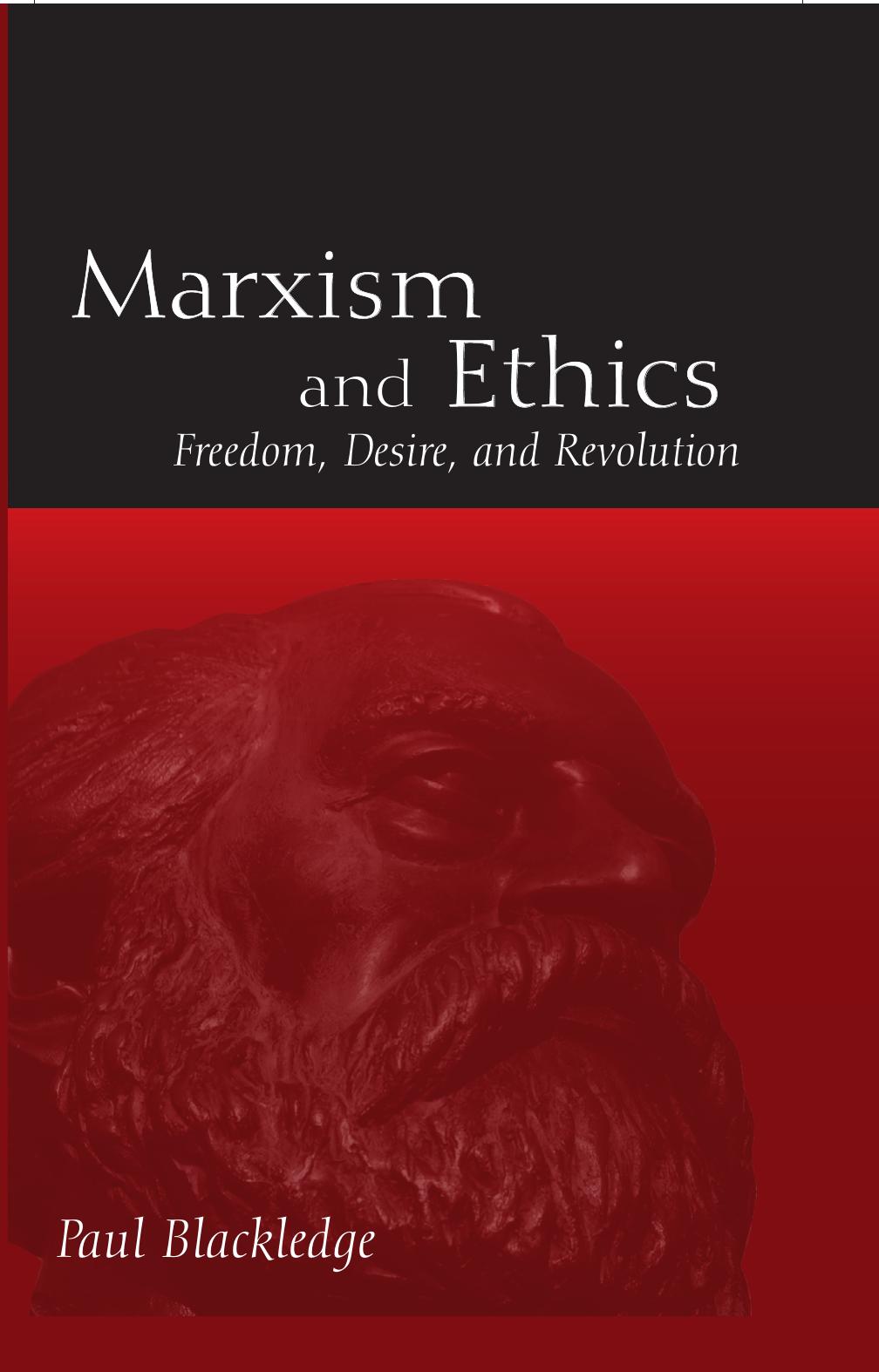
Author:Blackledge, Paul [Blackledge]
Language: eng
Format: epub, pdf
ISBN: 9781438439921
Publisher: State University of New York Press
Published: 2012-02-14T05:00:00+00:00
Revolutionary Ethics
If Lenin, Lukács, and Grossman all added to the renewal of Marxism through a break with Second International dualism, it is unfortunate that none of them made more than tentative comments on the ethical dimension of socialism. Thus, whereas we have noted Lukács' critique of Kant's ethics, and while I have elsewhere commented upon the ethical dimension of Lenin's Marxism (Blackledge 2006a, 66), no Marxist associated with the Comintern wrote a study of ethics that could compete with the scope of Kautsky's small book. Nevertheless, three works were produced in this period which pointed toward a Marxist ethics: Evgeny Pashukanis's Law and Marxism (1924), Leon Trotsky's Their Moral and Ours (1938), and Ernst Bloch's The Principle of Hope (1938–1947). Additionally, Lukács' and Gramsci's comments on the need to root revolutionary politics in working-class struggle are highly suggestive of the practical shape of an ethical Marxism.
According to Pashukanis there exists an intimate and necessary relationship between the emergence of the idea of individual equality and the system of generalized commodity production: “For the products of human labour to be able to relate to each other as values,” he wrote, “it is necessary for people to relate to each other as autonomous and equal personalities” (Pashukanis 1978, 151). Pashukanis insisted that three conditions must be satisfied for capital accumulation to become generalized: people must become “moral subjects,” “legal subjects,” and they must live their lives “egoistically.” Corresponding to this situation, moral law, far from being a universal good, is best understood as the ideological form necessary to regulate the “intercourse between commodity owners.” A consequence of the relationship between morality as the ideology of free action and capitalism as a system of social compulsion, Pashukanis argued that there is a necessary ambiguity in the moral law whereby, on the one hand, it presents itself as the rational basis for the actions of free individuals, while, on the other hand, it is a social law standing above individuals (Pashukanis 1978, 154). The only way to rid the moral law of this ambiguity, he claimed, is to eliminate capitalism through the creation of a planned economy. In so doing, the atomized nature of our present-day individuality would be overcome, and so would the basis for the ethical form itself (Pashukanis 1978, 158). Thus, just as the struggle for socialism involves a struggle against states and laws, it similarly involves the struggle against morality (Pashukanis 1978, p. 160; on Pashukanis see Miéville 2005, 75–115).
Trotsky's pamphlet, Their Morals and Ours, written in a more concrete register than Pashukanis' book, was produced as an explicit challenge to those for whom Marxism was a crude form of moral consequentialism according to which “the ends justified the means.” In opposition to such interpretations of Marxism, Trotsky first insisted that any adequate ethical theory must have an eye to the ends of action, as the alternative most fully expressed by Kant, could not survive without the idea of God, and thus represented a backward step after Darwin (Trotsky 1973, 16–7).
Download
This site does not store any files on its server. We only index and link to content provided by other sites. Please contact the content providers to delete copyright contents if any and email us, we'll remove relevant links or contents immediately.
| Anthropology | Archaeology |
| Philosophy | Politics & Government |
| Social Sciences | Sociology |
| Women's Studies |
The Secret History by Donna Tartt(19102)
The Social Justice Warrior Handbook by Lisa De Pasquale(12197)
Thirteen Reasons Why by Jay Asher(8918)
This Is How You Lose Her by Junot Diaz(6893)
Weapons of Math Destruction by Cathy O'Neil(6284)
Zero to One by Peter Thiel(5807)
Beartown by Fredrik Backman(5766)
The Myth of the Strong Leader by Archie Brown(5512)
The Fire Next Time by James Baldwin(5454)
How Democracies Die by Steven Levitsky & Daniel Ziblatt(5224)
Promise Me, Dad by Joe Biden(5157)
Stone's Rules by Roger Stone(5090)
A Higher Loyalty: Truth, Lies, and Leadership by James Comey(4966)
100 Deadly Skills by Clint Emerson(4931)
Rise and Kill First by Ronen Bergman(4797)
Secrecy World by Jake Bernstein(4756)
The David Icke Guide to the Global Conspiracy (and how to end it) by David Icke(4722)
The Farm by Tom Rob Smith(4517)
The Doomsday Machine by Daniel Ellsberg(4493)
